How the double touch rule is changing in amateur tournaments
Everything you need to know about the double contact rule change in setting to avoid on-court arguments during your amateur tournaments.
If you play in amateur tournaments, you will have seen endless arguments dozens of times over a slightly "dirty" set. The good news is that the rules of the game are evolving to favour the continuity of play and limit overly strict refereeing. Anyone taking to the court today needs to know that on the team's second touch, i.e. the set to rebuild the attack, referee tolerance has increased significantly. This means fewer interruptions, longer rallies and much more fun, as long as you know the limits of this mini-revolution.
The team's second touch is no longer a nightmare
In recent years, federations and amateur sports promotion bodies have promoted a new interpretation of the double touch fault, commonly known as a "double". If the setter makes the team's second touch, sending the ball towards a teammate for an attack, non-simultaneous contact of the hands must not be automatically penalised.
This does not mean that anything goes. If the set is visibly caught or if the player clearly carries the ball, the referee will still blow for a fault. However, if the ball spins slightly after impact or if the fingers do not touch the leather at the exact same millisecond, play must continue. The goal is to reward defensive effort and avoid interrupting the game for purely aesthetic imperfections that do not give a real advantage to the attacking team.
How the rule applies in six-a-side and beach volleyball
The distinction between the different disciplines is fundamental to avoid errors of judgement during weekend matches. The dynamics change significantly depending on the surface and the game format.
In the classic six-a-side game, played on a regulation 18x9 m court with the net set at 2.43 m for men and 2.24 m for women, matches are played as the best of sets to 25 points (with at least a two-point lead) and a potential tie-break to 15 points. In this context, applying the new tolerance on the second touch is now the norm. For youth tournaments or mixed formats, the net height and specific details must instead be checked in the regulations of the individual event.
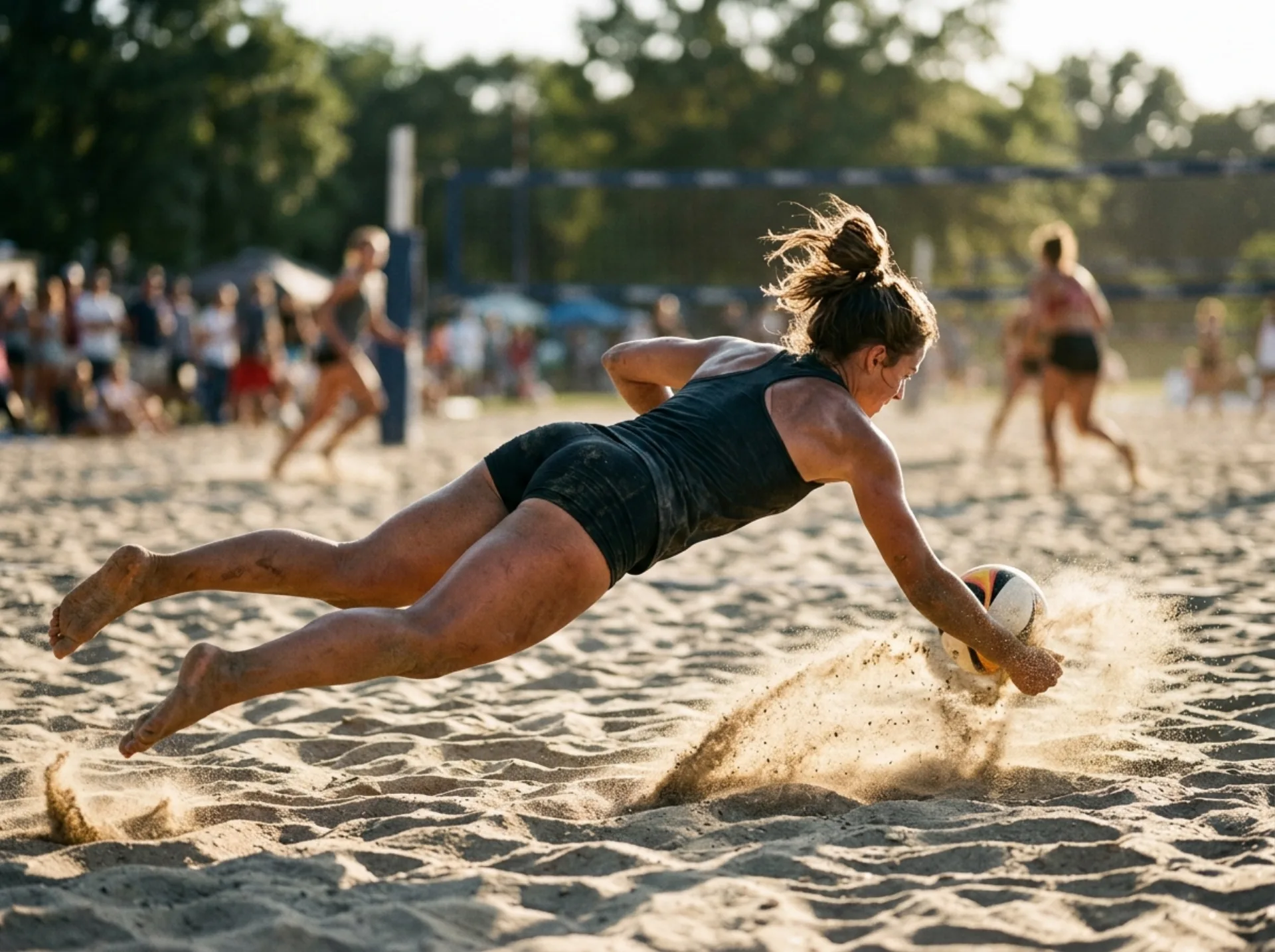
The tune changes drastically on the sand. In two-a-side beach volleyball, played on a 16x8 m court with sets to 21 points and a tie-break to 15 points, strictness on setting remains extremely high. Any visible spin of the ball or non-simultaneous contact in the set is almost always penalised as a double fault. For this reason, in sand tournaments, the vast majority of amateur players prefer to use an underhand pass (bump) to set, avoiding giving away easy points to the opponents. If you participate in mixed or outdoor amateur tournaments, always check the local rules before you start warming up.
What amateur players usually get wrong
The real problem in tournaments without an official referee, or where teams take turns refereeing, is self-regulation. Many players have the habit of stopping mid-play, shouting "double!" as soon as they see an imperfect set by their opponents. This is the most common and annoying mistake: until you hear the whistle of the person directing the match, play must never be interrupted.
Another frequent mistake is expecting professional refereeing in a mid-level amateur context. Applying extremely strict parameters constantly breaks up the game, taking away the rhythm of the match and fraying tempers. The modern rule on the second touch serves precisely this purpose: to keep the game moving and keep it fun, letting the attack or defence decide the point, not a fraction of a second of imperfect contact on the fingers.
Practical guide to setting without faults
To improve the effectiveness of your setting and avoid disputes, it is useful to focus on a few key technical elements that minimise the risk of committing obvious faults:
- Body position under the ball: The secret to a clean set is speed of movement. You must already be stationary under the trajectory of the ball before raising your hands, with your feet firmly planted on the ground.
- Cupped hand shape: Fingers must be open and relaxed, ready to receive the ball by recreating its round shape. If you keep your hands too flat or rigid, the impact will inevitably be asymmetrical.
- Coordinated pushing movement: Setting is not done with finger strength alone. It is a fluid movement that starts from the legs and is transmitted through the coordinated extension of elbows and wrists.
- Correcting the typical mistake: If you tend to push more with one hand than the other, the ball will come out with a lateral spinning motion. Train against a smooth wall by performing repeated sets at a short distance, focusing on the uniformity of the sound of the bounce.
Understanding these dynamics helps you experience matches with less stress and more focus on the actual game. If you want to organise a match among friends to test these rules on the court or create an amateur tournament without going crazy with schedules, apps like VolleyFriends help you manage sign-ups and coordinate logistical details in just a few steps.