How to set up a summer volleyball court to play with friends
All the secrets to choosing and setting up volleyball equipment in summer. From court dimensions to net tension, here is how to prepare the playing area for your amateur matches.
Summer is the perfect season to gather friends and organise a great outdoor volleyball match. Whether you are in a private garden, a park or on a beach, setting up a temporary court is the first step to kick off the fun in total safety. People often think that just pulling a string between two trees is enough to start playing, but a properly set up court avoids arguments over disputed points and protects players from annoying injuries.
In this guide, we will look at how to choose the right equipment and how to position it easily, so you can focus only on your spikes and spectacular defences.
Finding the right space to play safely
Even before unrolling the lines or driving in the net posts, it is essential to choose the playing area carefully. The surface must be as flat as possible and free of obstacles that could cause falls or sprained ankles.
If you play on grass, make sure there are no hidden holes, protruding stones, fallen branches or exposed roots. If you prefer sand, check that the area is clean and free of sharp objects. Another element to consider is the space outside the court: to move freely and retrieve the most difficult balls, it is advisable to maintain a safety zone of at least two or three metres free of trees, low walls or fences around the playing perimeter.
Official measurements to keep in mind
To recreate the true atmosphere of a match, the ideal is to respect the standard dimensions of the playing courts. Depending on your preferred discipline and the number of participants, the measurements change precisely:
- Classic volleyball (6-a-side play): The regulation court measures 18 metres in length by 9 metres in width. The space is divided in half by the net, creating two perfect squares of 9 metres per side for each team.
- Beach volleyball (2-on-2 play): If you prefer the doubles format on sand, the official court is slightly smaller and measures 16 metres in length by 8 metres in width, divided into two equal halves.
For any other variant, such as amateur mixed tournaments or youth categories, we remind you that the specific requirements and court dimensions must be checked in the official regulations of the individual event you intend to organise or attend.
How to choose and set up the net
The net is the heart of the playing court and its height must be carefully adjusted to ensure a balanced challenge. Again, there are very precise standard values to follow for your adult matches:
- Men's net: The official height is 2.43 metres, measured from the centre of the court.
- Women's net: The official height is 2.24 metres.
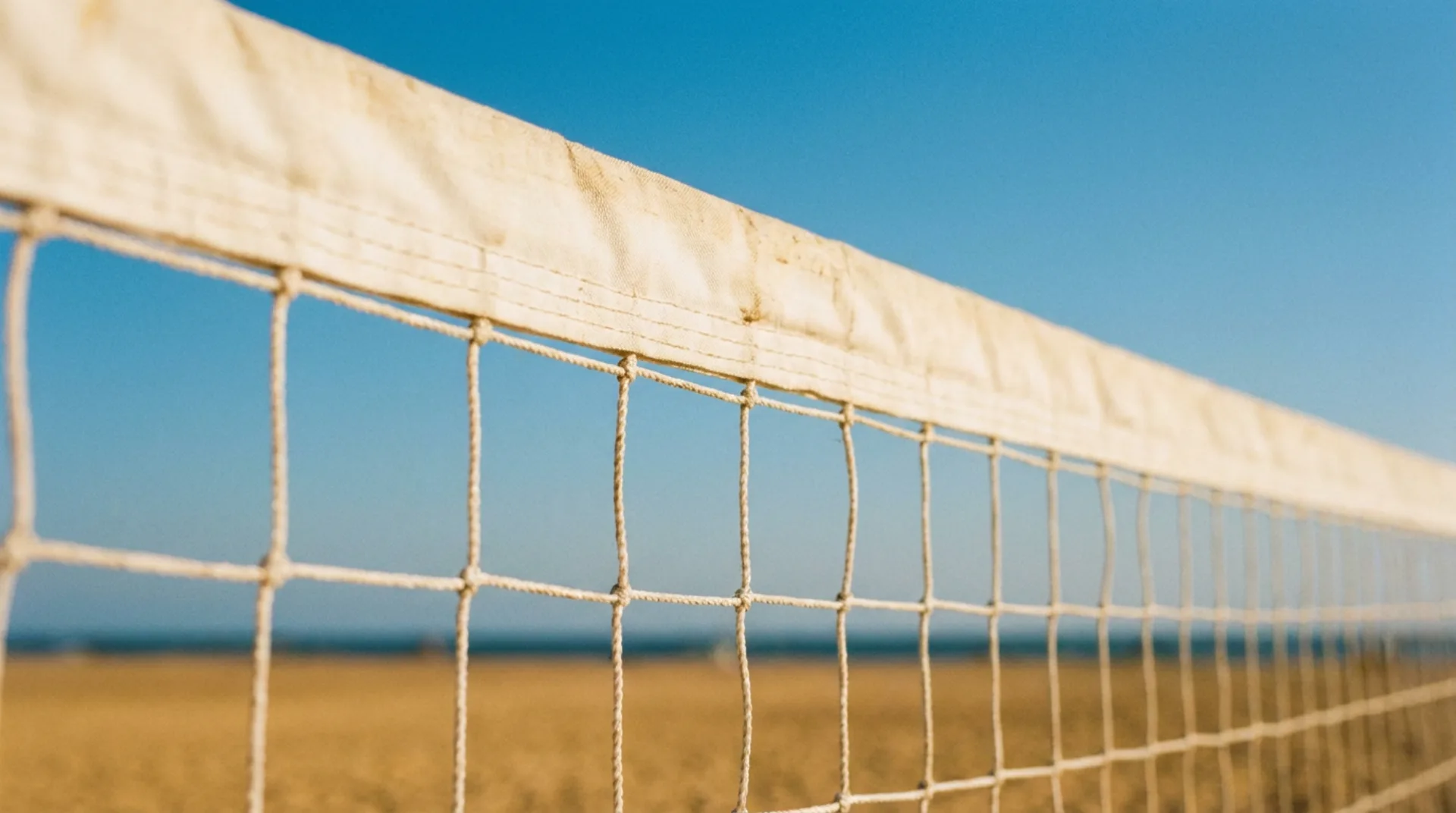
To set up the net optimally on a temporary ground, portable kits with telescopic posts are the most practical solution. These posts are usually secured to the ground using pegs and tension ropes. When tensioning the net, make sure there is no excessive sagging in the middle: the central part must not drop visibly compared to the height measured above the sidelines. If you organise youth tournaments or events with specific mixed rules, the net height must be checked in the event regulations.
Securing the lines without risking injuries
Marking the boundaries of the court is essential to avoid arguments over every ball that lands near the lines. Coloured tape lines, usually about 5 centimetres wide, are the best tool because they remain clearly visible on both grass and sand.
Here are the key steps to position the lines correctly and safely:
- Laying out the rectangle: Unroll the tapes starting from one corner and try to form precise right angles using visual references or by measuring the diagonals.
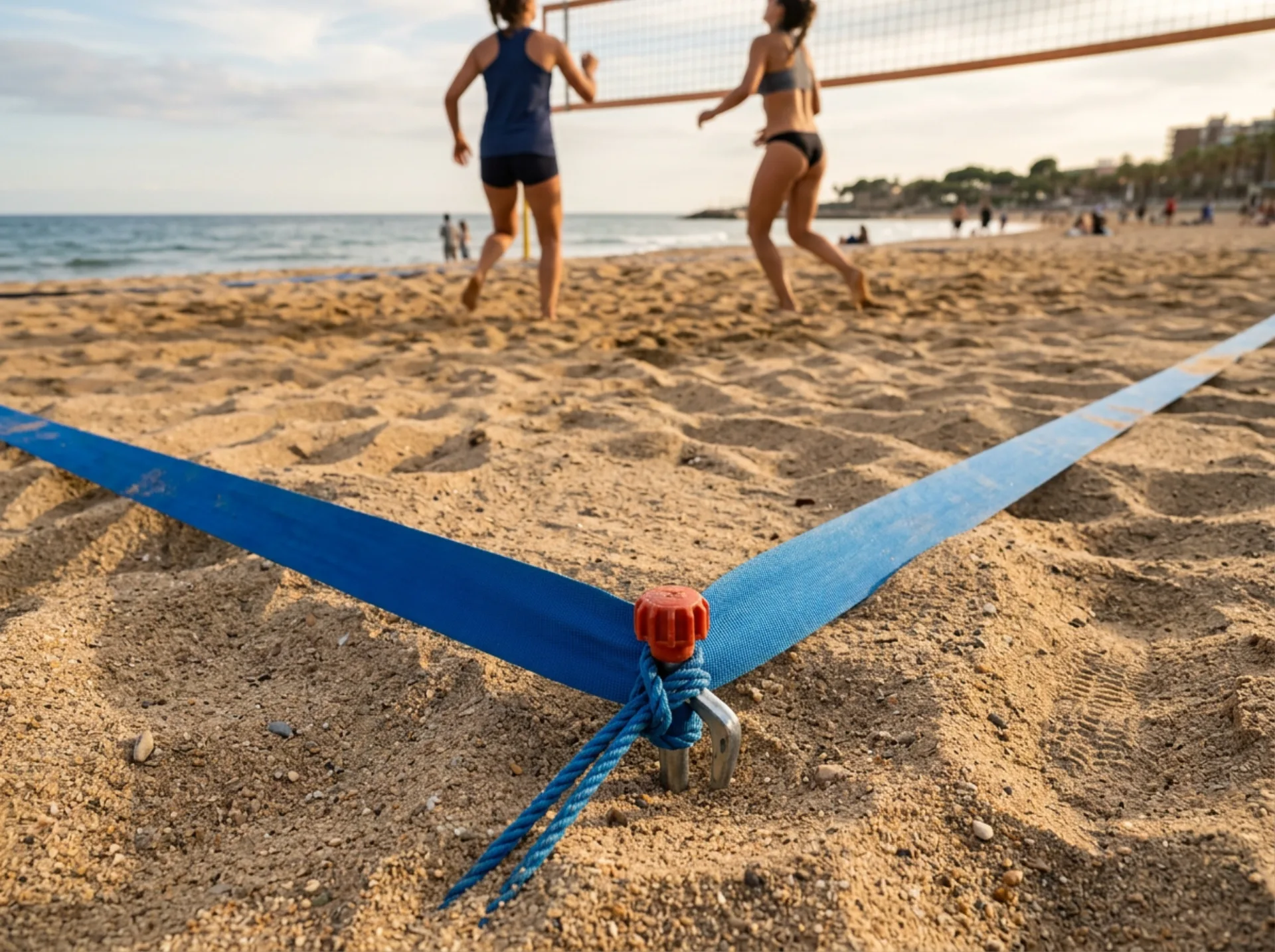
- Securing the corners: Use the pegs provided, preferably flat-profile plastic or metal ones, and push them completely into the ground or sand. There must never be any protruding parts that players could trip over.
- Tensioning the tapes: The lines must be taut to prevent them from moving with the wind or during play. A loose line represents a tripping hazard during fast movements.
Organising the perfect match
Once the court setup is complete, you are ready to blow the whistle to start the game. Remember that for a classic 6-a-side match, you play the best of three or five sets, where each set is won by reaching 25 points with at least a two-point lead over the opponents. In the event of a two-all tie, the deciding set (called the tie-break) is played to 15 points, again with a two-point lead. In doubles beach volleyball, however, regulation sets are played to 21 points, with any final tie-break to 15 points.
Having a well-set-up court transforms a simple day outdoors into a real sporting event. Gathering friends, splitting into teams and spending an afternoon dedicated to movement and laughter is very simple: all it takes is a little attention when choosing the space and the right equipment to bring unforgettable challenges to life.